




 Return to Blog
Why SaaS Marketing Teams Still Rebuild Pipeline Reports Every Week
SaaS marketing teams don’t lack data. They lack a reliable marketing reporting system that clearly and confidently brings pipeline, attribution, and revenue metrics together.
 Casey Ciniello
5min read
Casey Ciniello
5min read
 ChatGPT
 Perplexity
Executive Summary:
SaaS marketing teams don’t lack data. They lack a reliable marketing reporting system that clearly and confidently brings pipeline, attribution, and revenue metrics together.
This cycle is common across SaaS marketing reporting environments where data lives across CRM, analytics, and paid media systems.
Despite modern marketing reporting tools, many teams still:
- Export data from HubSpot
- Reconcile numbers in Salesforce
- Cross-check attribution in GA4
- Rebuild slides before executive meetings
Not because they enjoy it. Because they don’t fully trust their reporting system.
What Is Marketing Reporting in SaaS?
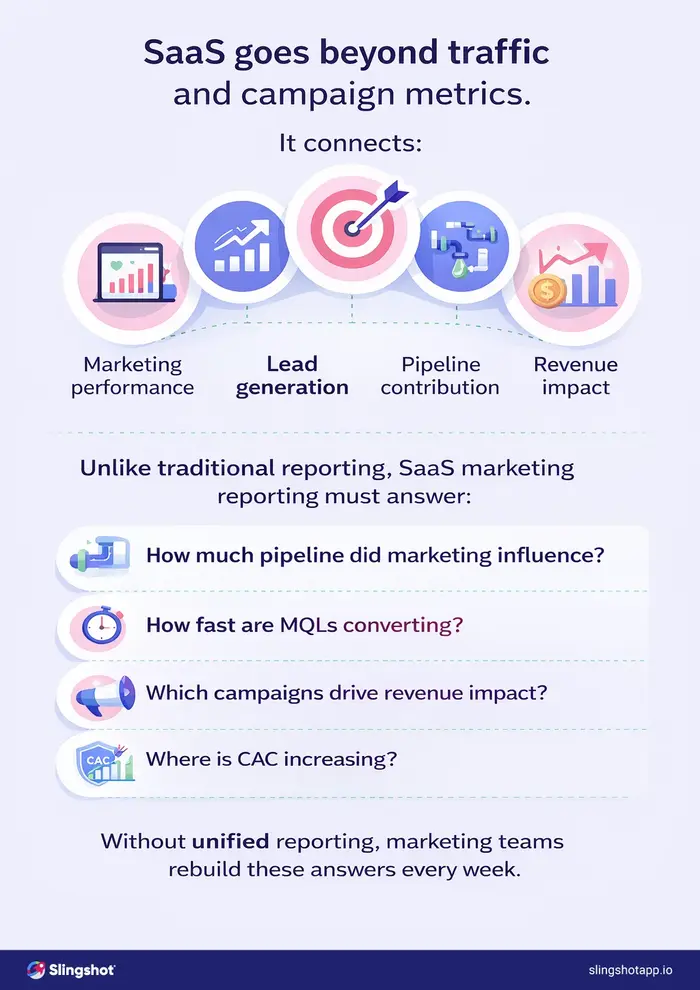
Most SaaS marketing teams use:
- Marketing performance
- Lead generation
- Pipeline contribution
- Revenue impact
Unlike traditional reporting, SaaS marketing reporting must answer:
- How much pipeline did marketing influence?
- How fast are MQLs converting?
- Which campaigns drive revenue impact?
- Where is CAC increasing?
Without unified reporting, marketing teams rebuild these answers every week.
The Reporting Problem Isn’t Volume. — It’s Fragmentation.
Most SaaS marketing teams use:
- HubSpot or Marketo
- Salesforce
- Google Analytics
- Paid media dashboards
- Sometimes Looker or Power BI
Each tool works. But none of them tells the whole story. SoSo, reporting becomes a stitching exercise.

Marketing Reporting Automation vs Manual Reporting
Many marketing reporting tools promise visibility, but few connect reporting to coordinated execution.
Manual Marketing Reporting
- Exporting from HubSpot
- Pulling Salesforce reports
- Reconciling numbers in Sheets
- Rebuilding executive decks
Marketing Reporting Automation
- Live synced dashboards
- Unified attribution view
- Shared KPI visibility
- Connected execution tracking
Automation removes friction, but automation without execution still leaves a gap.

Executive Scrutiny Is Increasing
In SaaS, marketing is accountable for pipeline.
Leadership doesn’t ask: “How’s traffic?”
They ask:
- Why did pipeline dip?
- Why did MQL velocity slow?
- What’s driving CAC?
- Is this campaign influencing revenue?
When reporting requires manual reconciliation, credibility suffers. Marketing leaders don’t just want dashboards. They want confidence.
Why Dashboards Alone Don’t Solve It
Most marketing reporting software focuses on visualization.
Dashboards show:
- MQL trends
- Pipeline numbers
- CPA shifts
- hannel performance
- Is this campaign influencing revenue?
But when performance changes, what happens next?
Usually:
- Slack thread
- Separate task board
- Meeting
- Manual follow-up
The reporting stops at insight,and momentum slows. Execution happens somewhere else.
The Real Cost of Rebuilding Reports
It’s not just time. It’s:
- Slower executive updates
- Misalignment between marketing and sales
- Reactive performance management
- Decision fatigue
If every update requires re-explaining the system, the system isn’t working.
What Modern SaaS Marketing Reporting Should Look Like
Instead of:
Tool → Export → Reconcile → Slide → Defend
It should look like:
Unified View → Context → Action → Impact
That means:
- One trusted performance view
- KPIs connected to the work influencing them
- Attribution transparency
- Coordinated follow-through
From Pipeline Signal to Coordinated Action
When pipeline dips, high-performing teams:
- See it immediately
- Assign corrective action
- Track execution
- Monitor impact

The Shift Toward Revenue-Accountable Marketing
Revenue-focused marketing reporting requires more than dashboards. It requires accountability. SaaS marketing isn’t just about traffic.
It’s about:
- Pipeline contribution
- MQL → SQL velocity
- Revenue impact
- Cross-team alignment
That requires reporting software that connects data and execution.
Not more dashboards.
Where Slingshot Fits
Slingshot was built for revenue-accountable marketing teams.
It connects:
- Pipeline performance
- Campaign execution
- Ownership tracking
- Executive-ready views
So, when leadership asks:
- “What changed?”
- You don’t rebuild a deck.
- You show a system leadership can trust.
Stop Rebuilding. Start Leading.
If your team is still stitching reporting together every week, the issue isn’t your data. It’s the disconnect around it.See how Slingshot brings reporting clarity and coordinated action into one system.
Final Thoughts
Modern SaaS marketing teams don’t need more dashboards.
They need:
- One trusted view
- Clear attribution
- Coordinated execution
- Revenue-level visibility
Reporting shouldn’t feel like defense. It should feel like leadership.
Frequently Asked Questions About SaaS Marketing Reporting
Marketing reporting in SaaS connects campaign performance, lead generation, pipeline contribution, and revenue impact into a unified view. Unlike traditional reporting, it must show how marketing influences revenue, — not just traffic.
Pipeline reporting software helps marketing and revenue teams track how campaigns influence opportunity creation, MQL-to-SQL conversion, and revenue outcomes. It connects CRM data with marketing performance metrics.
Because their data lives in separate systems and there is no unified reporting, teams manually export, reconcile, and recreate views to answer executive questions.
- Pipeline contribution
- Attribution visibility
- Conversion velocity
- Campaign performance
- Revenue impact
- Clear ownership on of corrective actions
Ready to grow your business 10x with AI decision-making?
Request a Free Demo of SlingshotSHARE THIS POST