



Marketing Operations Software
for Connected Teams
Marketing operations software that connects performance data, campaign execution, and team workflows into one system.

Slingshot ensures your reporting lives next to your tasks. Your data connects to your work. Insights trigger action without a context switching or delay by:
Connecting marketing data and reporting
Unifying marketing data and reporting
Coordinating campaign execution
Providing campaign and workflow management
Aligning teams and workflows
Making execution connect with performance
Turning insights into action
Giving real-time visibility across teams
Why Marketing Operations Breaks Down
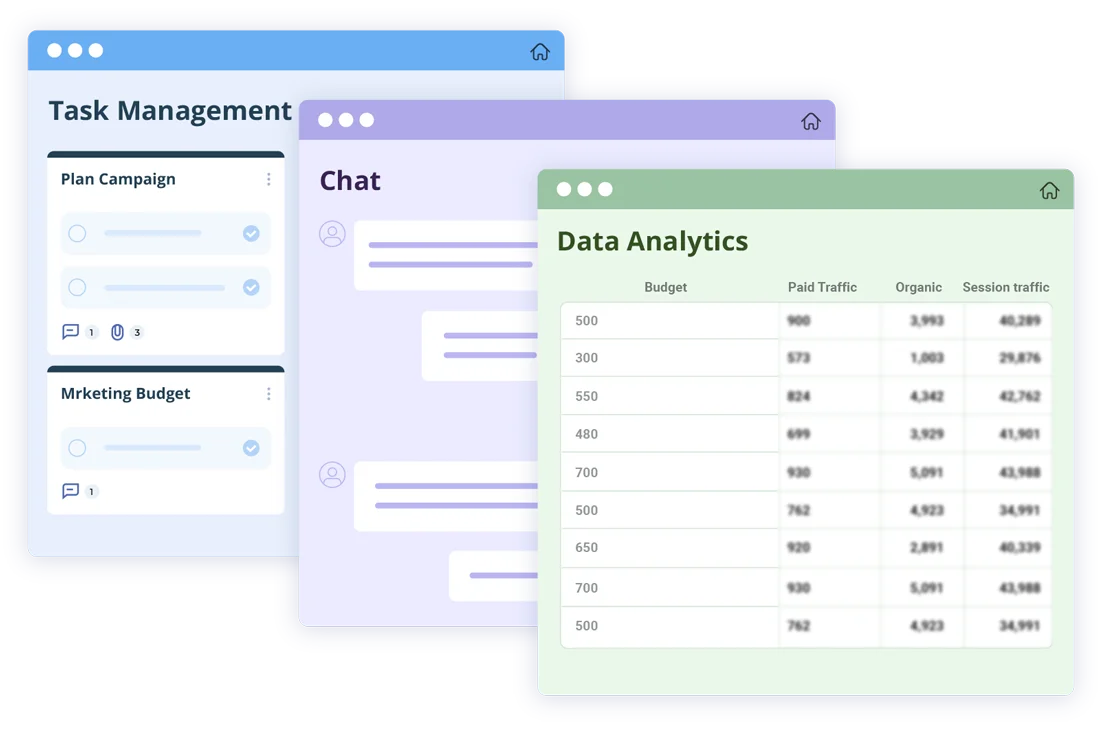
Most marketing operation teams run on three or four disconnected tools. Analytics in one place. Tasks somewhere else. Conversations in another tab entirely.
A system that’s always one step behind:
- Performance data lives in your analytics tool (GA4, HubSpot, Salesforce), but no action is taken directly from it.
- Work lives in your project tool (tasks, campaigns, deadlines), but it has no connection to the data that supports it.
- Decisions happen in chat or in meetings, separately.
- Data Lives in One System: Analytics tools track performance.
- Work Lives Somewhere Else: Tasks and campaigns are managed separately.
- Communication Happens Elsewhere: Decisions are made outside both.
This creates gaps:
- Insights don’t trigger action
- Work is delayed
- Teams lose alignment

EXAMPLE
A Campaign Underperforms
- The dashboard shows it.
- The team discusses it.
- Tasks are created later.
- By the time action happens, performance has already dropped.
That’s not a people problem. It’s a systems problem. When your reporting tool can’t trigger an action, and your project tool has no performance context, every response requires a manual handoff. That costs speed. It costs clarity. And over time, it costs you confidence in the data because by the time you act on it, it’s already stale.
That gap between insight and action is where marketing operations break down. The fix isn’t more tools. It’s a connected system where data and execution live together.
Read more: How to Build a Marketing Reporting System
What Modern Marketing Operations Require
Fixing marketing ops isn’t about adding another tool. It’s about replacing the gaps between them. A modern marketing operations platform needs to do four things in one place — a connected system.

Centralized Data
All performance in one place.

Workflow Management
Campaigns and tasks structured.

Execution Coordination
Clear ownership and actions.

Real-Time Response
Insights trigger action immediately.
How Slingshot Connects Insight and Execution
Slingshot brings your marketing data and work into a single, connected system. Here’s what that looks like in practice.
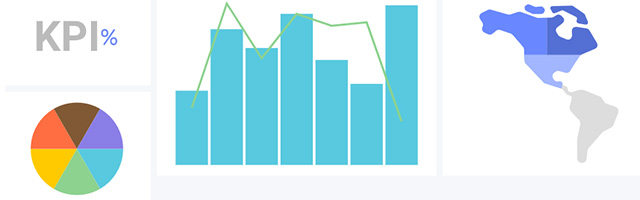
See your marketing KPIs (pipeline, MQLs, campaign performance) alongside the work your team is doing to influence them. Slingshot Overviews give you one live view of what’s changing and what’s being done about it. Instead of building a separate status report, your team always has a current picture of performance and progress in one place.

Connect GA4, HubSpot, Salesforce, Facebook Ads, LinkedIn Ads, Marketo, and 50+ other platforms. See cross-channel performance, funnel metrics, spend vs. revenue, and campaign contribution in one reconciled dashboard without rebuilding reports manually. When numbers shift, you see it immediately and can act from the same view.

Plan and run campaigns with full visibility into ownership, deliverables, and timelines. Use a Kanban board to track campaigns from concept to live, with performance data attached directly to each campaign workspace. Your team knows what’s in flight, who owns what, and how each campaign is performing without switching between tools.

Create tasks directly from data. When a metric signals a problem (a CPA spike, a drop in MQL volume, a conversion rate below target), you can assign a corrective action on the spot. Ownership, deadline, and context stay together. No copy-pasting insights into a separate project tool and no loss of context in the handoff.
Discuss results, flag performance shifts, and align on next steps inside the same workspace as your data. Context stays attached to the relevant campaign or metric, not buried in a Slack thread from three weeks ago. Marketing and sales teams can align on pipeline without running a separate sync.

Access files from Google Drive, OneDrive, or SharePoint and pin them to the relevant campaign workspace. Creative assets, briefs, and deliverables stay connected to execution, so your team doesn’t have to hunt for files when a campaign needs to move.
Read more: From Campaign Insight to Action


Templates Built for Marketing Operations

Paid Media Template
Manage campaign execution across paid channels with built-in task tracking and performance visibility.

SEO Management Template
Coordinate SEO workflows, track content progress, and monitor keyword rankings in one place.

Paid Performance Dashboard
Visualize spend, conversions, and ROI across paid campaigns without rebuilding your reporting from scratch.

Content Calendar Template
Plan and manage content production with ownership, deadlines, and status tracking built in.
How Teams Use Slingshot
You own the systems, the reporting, and the workflows. The problem is that those three things rarely live in the same place. Slingshot gives you one system to manage them all. Connect your data sources, build dashboards your team can act on, and keep campaign execution aligned with the data. When something shifts, your team responds from the same place they’re already working.
No handoff required.
When a campaign underperforms, speed matters. A spike in CPA or a drop in lead volume needs an immediate response, not a task created two days after someone noticed it in a dashboard.
Slingshot connects your performance data to your execution workflows, so you can spot the signal and act on it in the same view. That means faster optimization cycles and fewer gaps between what the data shows and what your team does about it.
Pipeline visibility shouldn’t require a manual data pull before every sync. Slingshot gives RevOps teams a reconciled view of pipeline contribution, campaign performance, and team execution across HubSpot, Salesforce, and your ad platforms. Run cleaner reviews, answer questions on the spot, and move faster on what matters. No more reconciling numbers across systems the night before a board update.


Why Traditional Tools Fall Short
Most teams try to solve the marketing operations management problem by adding more tools. It doesn’t work. It just adds another gap.
| Capability | Analytics Tools | Project Management Tools | Slingshot |
|---|---|---|---|
| Cross-channel performance data | ✓ | ✕ | ✓ |
| Campaign and task management | ✕ | ✓ | ✓ |
| Create tasks directly from data | ✕ | ✕ | ✓ |
| Performance context attached to work | ✕ | ✕ | ✓ |
| Real-time collaboration on results | ✕ | Partial | ✓ |
| Connects to 50+ marketing platforms | Varies | ✕ | ✓ |
| One unified workspace | ✕ | ✕ | ✓ |
Analytics tools show you what happened. Project tools track what you’re doing. Neither connects the two. Slingshot does.
Frequently Asked Questions
Marketing operations software is a platform that manages the systems, data, and workflows that keep a marketing team running. That includes performance reporting, campaign coordination, workflow management, and the processes that connect them. The goal is to reduce manual coordination and give teams a reliable, fast way to move from insight to action without the delays of managing each of those steps in separate tools.
A marketing operations platform centralizes your reporting, structures your workflows, and connects execution to performance data. Instead of pulling numbers from one tool and managing tasks in another, your team works from a single system where data and action live together. Modern platforms like Slingshot connect directly to your existing tech stack (HubSpot, Salesforce, GA4, and others), so you’re not re-entering data or rebuilding reports manually before every campaign review or exec update.
The most common reason is disconnection. Teams use an analytics tool for reporting, a project tool for tasks, and a chat tool for decisions, and none of these talk to each other. When performance shifts, getting from data to action requires too many handoffs. By the time a task is created and assigned, the window to respond has already narrowed. The fix isn’t more tools. It’s a connected system where insight and execution are in the same place.
Campaign management is a subset of marketing operations. Campaign management covers the planning, execution, and tracking of specific campaigns. Marketing operations are broader. It includes the systems, reporting structures, data management, and workflows that support all marketing activities, not just individual campaigns. A strong marketing operations workflow handles both the day-to-day execution of campaigns and the systems layer that keeps everything running.
Slingshot connects your performance data directly to your execution layer. You can pull in data from 50+ platforms, see cross-channel performance in one reconciled view, and create tasks from that data without switching tools. Overviews give you a live view of KPIs alongside the work your team is doing to influence them. That means faster response times, less manual coordination, and clearer ownership across campaigns and workflows from the moment metric shifts to the moment the fix is confirmed.
Marketing operations leaders who manage reporting systems and campaign workflows. Demand gen teams that need to respond quickly when performance shifts. RevOps and growth teams that need pipeline visibility connected to execution. If your team spends time reconciling data across tools, manually coordinating what happens after a report, or rebuilding the same dashboards before every review, marketing operations software addresses that directly.
Slingshot connects to GA4, HubSpot, Salesforce, Facebook Ads, LinkedIn Ads, Google Ads, Marketo, Salesforce Marketing Cloud, Microsoft Dynamics, Google Search Console, and 50+ additional platforms. It also integrates with file storage tools, including Google Drive, OneDrive, SharePoint, Box, and Dropbox, so your assets and data sources are connected to the same workspace where your team executes.
Run Marketing Operations Without the Gaps
Connect data, workflows, and execution in one place.