





 Return to Blog
How to Stop Defending Your Marketing Numbers in Every Executive Meeting
Marketing leaders don’t lack data. They lack unified reporting. When metrics live acrossdisconnected systems, executives question the numbers instead of discussing strategy.
 Dian Jelyazkov
6min read
Dian Jelyazkov
6min read
 ChatGPT
 Perplexity
Executive Summary:
Marketing leaders don’t lack data. They lack unified reporting. When metrics live acrossdisconnected systems, executives question the numbers instead of discussing strategy.
And instead of discussing strategy, you’re explaining the math.
- “Why doesn’t this match last week’s number?”
- “Is this Salesforce pipeline or influenced pipeline?”
- “Does this include paid?”
- “Which attribution model is this?”
When you spend 40 minutes of a 60-minute meeting defending the validity of your numbers, you’re not leading the conversation. You’re defending the data.And that’s not a performance problem. It’s a reporting system problem.
The Strategy-Execution Gap: Why Traditional Dashboards Fail the C-Suite
Most marketing teams have reporting. Few have a clearly defined marketing reporting strategy.
Without consistent metric definitions, attribution logic, and standardized executive views, reporting becomes reactive instead of strategic.
When KPIs shift unexpectedly, confidence drops — even if performance hasn’t changed.
The Real Issue Isn’t Performance — It’s Trust
When executives question numbers, it usually signals one of three things:
- Metrics aren’t defined consistently
- Data lives in multiple systems
- Reports are rebuilt manually
Even strong marketing teams fall into this trap. Data might live in:
- HubSpot or Marketo
- Salesforce
- Google Analytics
- Paid media dashboards
- A BI tool
- A slide deck
Each tool works. But together? They create fragmentation.
So, before every executive meeting, someone exports data, reconciles metrics, rebuilds a slide, and hopes nothing changed overnight. That cycle erodes confidence — internally and externally.
The Most Common Pipeline Reporting Challenges
SaaS marketing teams face recurring pipeline reporting challenges:
- Conflicting numbers between CRM and marketing automation
- Attribution model confusion
- Delayed revenue reconciliation
- Lack of visibility into pipeline influence
- Inconsistent executive dashboard formatting
These challenges don’t signal poor performance. They signal fragmented systems.
Why Executive Scrutiny Is Increasing
Marketing is no longer evaluated solely on impressions or traffic.
Leadership wants answers to questions like:
- How much pipeline did marketing influence?
- What’s our MQL-to-SQL conversion rate?
- Where is CAC increasing?
- Which campaigns actually generate revenue?
- Why did pipeline dip this month?
If your reporting requires manual stitching, you will always be one question away from uncertainty. And uncertainty invites scrutiny.
The Hidden Cost of Rebuilding Reports
Rebuilding reports every week doesn’t just waste time; it also undermines the quality of the reports.
It creates:
- Slower executive decision-making
- Misalignment between marketing and sales
- Reactive performance management
- Internal doubt about attribution accuracy
When leadership doesn’t fully trust the system, they challenge the numbers. When they challenge the numbers, strategy conversations stall.
The Difference Between Reporting and Defensible Reporting
Most teams have dashboards. But dashboards alone don’t create confidence.
There’s a difference between: Showing numbers and operating from a trusted system
Defensible reporting requires:
- Clearly defined KPIs
- Standardized metric definitions
- Unified data sources
- Consistent attribution logic
- Visibility into the execution driving results
If a KPI changes, leadership shouldn’t ask, “Where did this come from?”
They should ask, “What are we doing about it?”
How to Shift From Defense to Leadership
Here’s what changes when marketing reporting is unified.
Define Metrics Once — and Lock Them
Every core KPI needs:
- A clear definition
- A documented calculation
- A consistent data source
MQL should mean the same thing in Salesforce, marketing automation, and executive dashboards.

Eliminate Manual Reconciliation
If someone is exporting CSVs before a meeting, you don’t have automation; — you have temporary alignment.
Modern systems, — like a unified marketing analytics platform, — should:
- Sync CRM and marketing data live
- Update dashboards automatically
- Maintain attribution transparency
- Surface pipeline impact without slide rebuilding
The goal isn’t prettier dashboards. It’s fewer pre-meeting scramble sessions.
Connect Performance to Execution
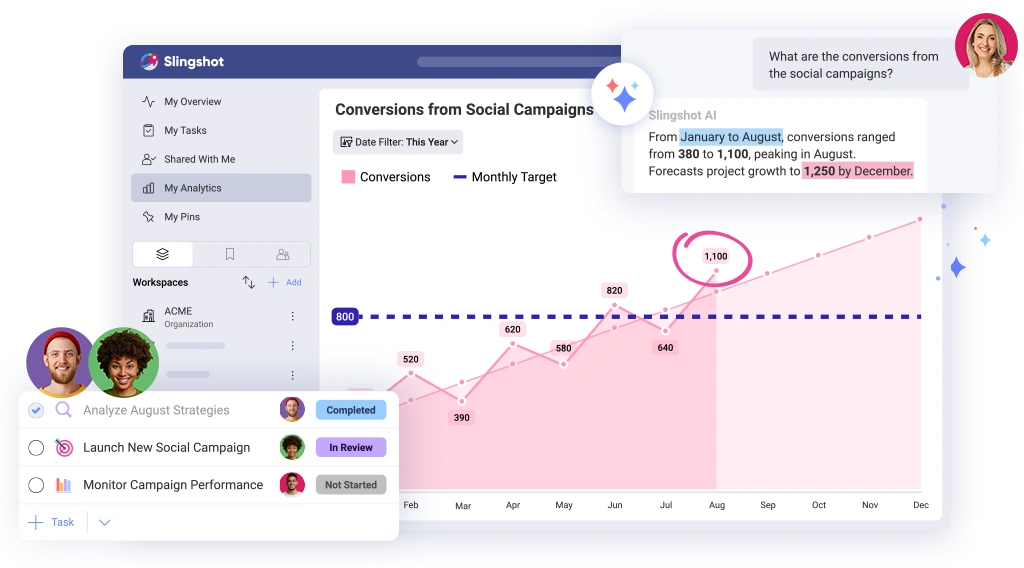
This is where most reporting systems break. You see a pipeline dip. Then what? Slack thread. Separate task board. Follow-up meeting. Disconnected.
When reporting connects directly to execution:
- A KPI shift triggers discussion
- A task gets assigned
- Ownership is clear
- Impact is monitored
Now performance changes lead to action, — not confusion.

Standardize Executive Views
Executive reporting should not vary meeting to meeting.
It should include:
- Pipeline contribution
- MQL → SQL velocity
- Revenue influence
- CAC trends
- Campaign-level impact
Well-structured executive marketing dashboards build trust because leadership sees the same format, every time. Consistency builds credibility.

The Psychological Shift
When reporting is fragmented, meetings feel adversarial. When reporting is unified, meetings feel strategic.
- Instead of: “Prove this works.”
- You hear: “How do we scale this?”
That shift changes your role in the room. You’re no longer explaining. You’re advising.
Frequently Asked Questions
A marketing reporting strategy defines how performance is measured, standardized, and presented to leadership. It includes KPI definitions, attribution logic, data sources, and the executive dashboard structure to ensure consistent, defensible reporting.
Common pipeline reporting challenges include inconsistent CRM data, unclear attribution models, mismatched MQL definitions, and manual reconciliation across tools. These issues reduce confidence in marketing’s reported revenue impact.
A strong marketing KPI dashboard should provide contextual transparency. This includes pipeline contribution, MQL-to-SQL conversion rates, revenue attribution, CAC trends, and campaign performance. It should connect performance data to the execution-influencing results.
Executive dashboards standardize how performance is presented. When leadership sees consistent metrics across pipeline, revenue, and conversion velocity, defensive conversations decrease and strategic discussions increase.
Unify your data sources and connect reporting directly to workflow execution. Automated dashboards, standardized metric definitions, and integrated CRM visibility eliminate manual reconciliation before executive meetings.
Stop Rebuilding. Start Leading.
If you feel like you’re defending your numbers in every executive meeting, the issue isn’t your performance. It’s the reporting system behind it. Move to a unified reporting model — and shift the conversation from defense to strategy.
Ready to grow your business 10x with AI decision-making?
Request a Free Demo of SlingshotSHARE THIS POST